Strengthening Aquaculture Through Record-Keeping: Evidence from Ghana’s Bono East Region
Aquaculture has become a cornerstone of Ghana’s food security strategy, with tilapia and catfish farms expanding rapidly to meet rising demand. Yet, beneath this growth lies a critical management gap: inconsistent record-keeping. Recent empirical research conducted among 120 fish farmers in the Bono East region shows both the high perception of record-keeping’s importance and the persistent threats to its adoption.
Evidence from the Field
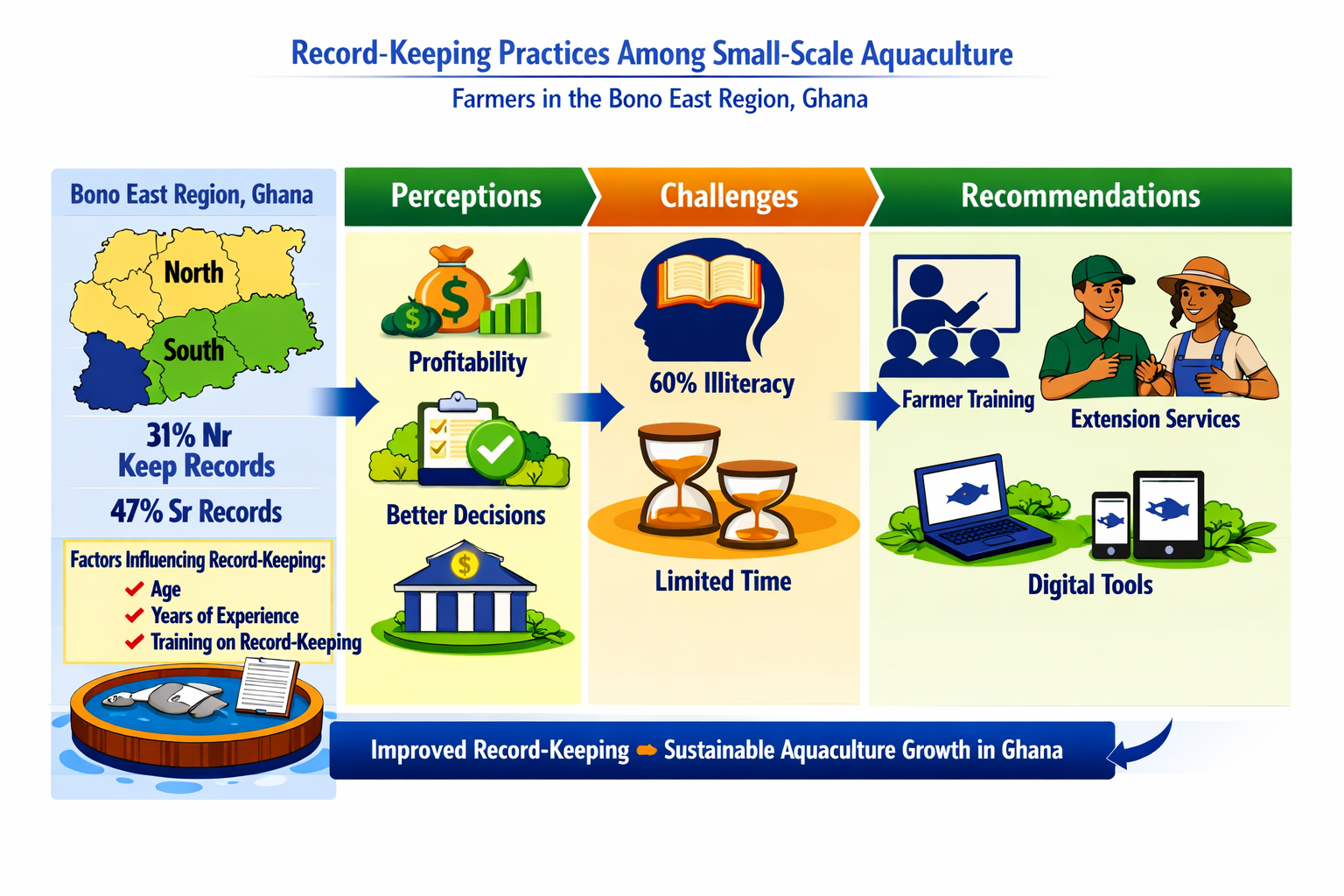
The study revealed that while farmers in both northern and southern Bono East strongly perceive record-keeping as essential for profitability, decision-making, and access to financial support (mean scores > 4.13), fewer than half maintain records regularly. Paper notebooks dominate as the recording format (100% in the North; 73% in the South), with negligible adoption of digital tools such as spreadsheets. Illiteracy (50–60%) and time constraints (30%) emerged as the most significant barriers, while training, age, and years of experience positively influenced record-keeping behavior.
Implications for Policy
The findings underscore the need for targeted interventions to institutionalize record-keeping as a pillar of aquaculture management. In Ghana, intensifying extension services at the district level is critical. Training programs delivered in local languages and simplified formats can help overcome literacy barriers. Linking record-keeping compliance to access to microcredit, subsidies, and national awards would incentivize adoption, while youth-focused digital literacy campaigns could ensure long-term sustainability. Moreover, government-private sector partnerships should subsidize mobile-based record-keeping applications and SMS systems to bridge the technology gap.
At the global level, standardized record-keeping frameworks developed by FAO and regional fisheries bodies would provide adaptable templates for diverse contexts. Open-source, multilingual digital tools with offline functionality are essential for low-resource communities. South-South cooperation, particularly between leading tilapia producers such as Egypt and Ghana, could facilitate knowledge exchange on record-keeping innovations. Integrating record-keeping into sustainability certifications would further incentivize adoption, while international databases for small-scale aquaculture records would enhance global monitoring, research, and food security planning.
Conclusion
Record-keeping is a fundamental management tool that determines the efficiency, profitability, and sustainability of aquaculture enterprises. For Ghana, strengthening record-keeping practices among small-scale fish farmers will not only improve productivity but also foster access to finance and resilience in a competitive sector. For the global community, harmonized record-keeping frameworks and digital innovations can elevate the role of aquaculture in achieving food security and sustainable development.